WITH new cars backed up by new low emission SKYACTIV technology, Mazda is positioning itself to be a significant business car brand choice for small businesses and SME fleets. Business Car Manager industry correspondent, John Griffiths, files this special report.
MAZDA was once memorably described as a “pilchard” by former Mazda Motors Europe chief James Muir in seeking to illustrate the modest-sized car maker’s vulnerable place in the automotive ocean’s food chain.
Now, with a flood of new technology and effectively completely renewed model ranges due to start rolling in from next year, Mazda is becoming increasingly bent on turning predator; its eyes fixed on what it hopes are the soft underbellies of larger rivals circling above.
And if all goes as planned, one of the earliest impacts will be felt in the UK business car market.
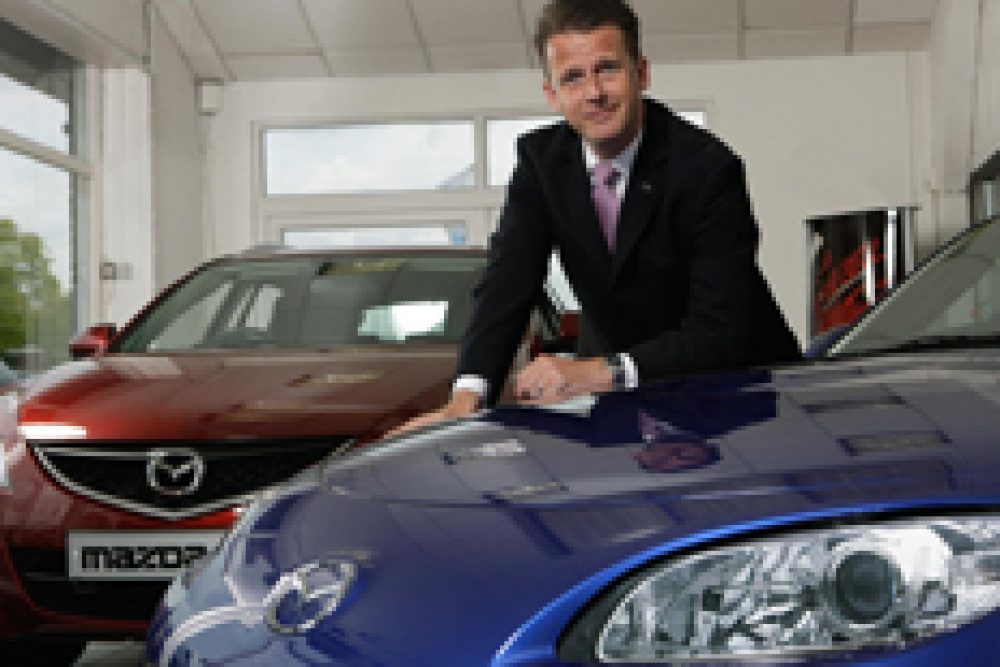
UK managing director Jeremy Thomson and fleet chief Steve Jelliss are launching a new strategic push to bite off a substantially larger chunk of fleet business than Mazda has either sought or achieved hitherto.
The main targets are the plethora of small and medium-sized companies operating fleets of 20 vehicles or more and Thomson and Jelliss currently are overseeing the recruitment of an additional core of fleet specialists to undertake the project. “It’s an area with good growth potential and in which we are keen on dealers investing,” Thomson explains.
The logic behind the push is persuasive. The UK retail car market remains flat, and with the Eurozone and other global economic ills far from resolution, many industry observers do not expect significant retail car market recovery any time soon. With only 34 per cent of its total UK sales non-retail, Thomson and Jelliss have good reason to seek to tap deeper into the so-far more resilient fleet and business car sector.
The challenge of maintaining Mazda residual values
Thomson appears relatively unconcerned about the potential of a concerted drive for fleet business to imperil the relatively high residual values Mazdas have typically achieved; the erosion of which would hardly be appreciated by Mazda’s significant majority of private buyers.
“Residuals get challenged when large numbers of cars are depreciated early (as with daily rental business) or when there is distress retailing involved. We will do neither,” he insists. “We would rather keep a tight lid and only put into the market what we ourselves can take back into the network. Mazda has tended to be in the top quartile of residuals and we want to keep that up.”
The UK business user initiative, however, is just a relatively small-scale precursor of what is to come globally, says Phil Waring, CEO of Mazda Motor Europe. Dealers across the world, having had a relative dearth of major new product for some time – and with stagnating sales as a result – are gearing up for the steady stream of entirely new, sixth-generation product, the first to deploy Mazda’s much-trumpeted SKYACTIV advanced engineering technology, that will start flowing into showrooms next year led by the CX-5 compact SUV. “I believe we are on the cusp of something new and important for the brand,” Waring adds.
The business car benefits of lower CO2 emissions
The SKYACTIV technology, which concentrates on refining current drivetrain technologies rather than on radical propulsion systems such as fuel cells, will deliver major fuel savings, emissions and whole-life cost reductions for business car users and SME fleet operators, according to Mazda engineers.
For the UK fleet and business sector in particular, Thomson expresses high hopes for the CX-5, which will offer all-new both petrol and diesel engines – “it will be the acid test for fleet growth.” The just-re-worked Mazda 3, the company’s biggest-selling car worldwide and which will go on sale in the UK next February, has a minor presence among business users but is viewed as the final knell of Mazda’s fifth-generation product. (It is still highly important to dealers, however, accounting for close to one quarter of Mazda’s 37,000 UK sales last year.)
Thomson expects Mazda’s total UK sales to be little or no higher this year but projects that the arrival of the new-generation product has the potential to lift annual sales over 50,000 “and some way beyond.”
That is not necessarily wishful thinking. The company has chalked up 50,000-plus sales three times in the past decade until recession and a relative new product hiatus started taking its toll.
Thomson predicts that growth will come from a collection of factors. “I believe the CX-5 will sell in much greater volumes than the (outgoing) CX-7. Unlike the CX-7, it will have an automatic transmission on offer to go with the diesel as well as 119g/km best-in-class CO2. It’s going to be ideal for user-chooser business drivers looking to their BIK.”
The all-new Mazda6, for which there is as yet no formal launch date, is also expected to emit a low, 105g/km arising from the SKYACTIV technology. “Taken overall, it’ll be good to have a full range of cars which are genuinely all new, including engines and transmissions. Mazda showrooms are going to look very different over the next three-four years.”
And it’s not just about styling, he insists. “I think buyers are taking a much more holistic view.” SKYACTIV, he predicts, will demonstrate that much can be done with internal combustion engine technology to make it a match for other innovative technology such as hybrids and adds that Mazda has no intention of creating a form of sub-brand within the company like BMW’s Efficient Dynamics. “The problem with the eco-badge solution is that the ordinary product then has to sit alongside it not looking so good.”
Waring himself says there are two important drivers of the fleet market: strong performances in CO2 reduction, with its associated BIK, VED and other financial benefits – or deep discounting. Given its high level of retail business, Mazda is steering well clear of the latter, he insists. “So the recovery in fleet business will be driven by CO2 and advanced new technology. The replacement for the Mazda 6 is targeted at 105g/km, for example.
“Not least, when it comes to hybrids, no-one really knows what the long-term costs are going to turn out to be. In terms of certainty, and that’s what’s important to the business user sector, what Mazda and some others are doing in terms of refining current core technologies is altogether more relevant.”
Read more
Interested by SKYACTIV technology? Read What is Mazda’s new fuel saving technology?