
Rugged, refined: Isuzu D-Max 2.2 review
Isuzu has made about as many changes to the D-Max’s engine as it could without throwing the whole thing in the bin.
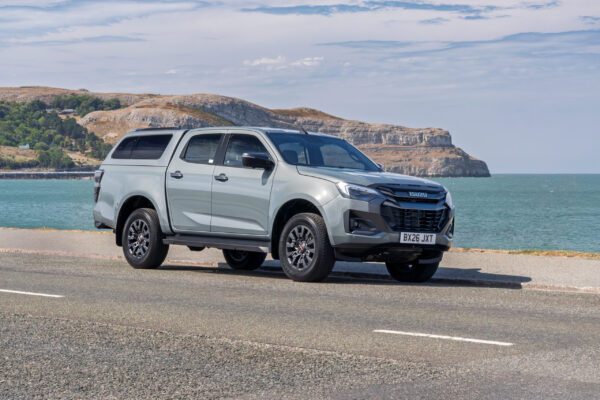
Tested: Isuzu D-Max 2.2 V-Cross
Specification
- Max power
- 163PS
- Max torque
- 400Nm
- Top speed
- 112mph
- 0–62mph
- 12.2 seconds
- WLTP economy / range
- 32.1mpg
- CO₂ emissions
- 229g/km
- BiK
- 37%
- VED
- £360
- OTR price
- £42,995 (excluding VAT)
Updates to the Isuzu D-Max seem to come thick and fast. Whether it is the launch of a new variant with huge tyres, the introduction of an electric model, or as in this case, a new engine, Isuzu cannot seem to just leave the thing alone.
This is for good reason. With the Trooper long consigned to the depths of Facebook Marketplace and the Piazza now a bona fide antique, the D-Max is the only model left in Isuzu’s UK passenger vehicle range, so it is vital that the truck is kept fresh.
The D-Max’s latest round of updates mainly centres around a new 2.2-litre diesel engine, which replaces the old 1.9-litre, though a few other niceties have also been added: two extra speeds in the automatic gearbox, some additional advanced driver assistance systems (ADAS), and a 360-degree camera.
Oily bits
Isuzu has made about as many changes to the D-Max’s engine as it could without throwing the whole thing in the bin. It has a new cylinder head, a new turbocharger, new pistons, and even a new block.
The name of the game here was to give the driver more of everything – except for power, which remains at 163PS. Compared with the 1.9, the 2.2 has 40Nm more torque, which is delivered earlier in the rev range, thanks to that new turbocharger. Isuzu also says the new unit is smoother, more efficient, and more durable.
While it is down on power and torque compared with some rivals, such as the twin-turbocharged Mitsubishi L200 or the six-cylinder Ford Ranger, the 2.2-litre is more than up to the task.
It is as responsive as a diesel can be, and is potent enough to overtake the odd tractor.
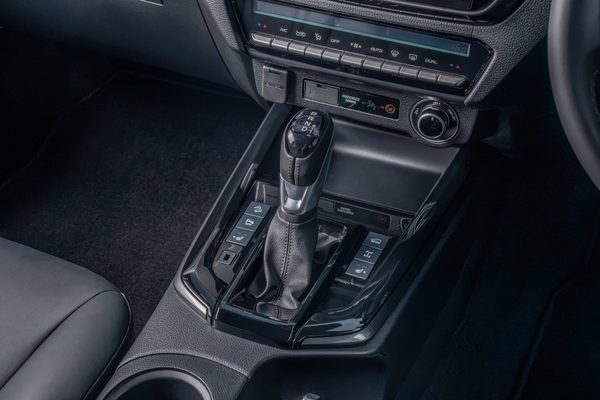
This is only helped by the excellent new eight-speed automatic gearbox. The unit is decisive and is far better at choosing the right gear for the job than others on the market. With eight ratios to choose from, the engine can be kept at a low, efficient speed when cruising, or right in its power band when worked hard.
Annoyingly, though, the power band roughly coincides with the point of maximum clatter in the rev range.
The clatter should not be enough to offend – after all, this is a working vehicle – but the 2.2’s manners are unlikely to impress anyone familiar with the best modern diesels.
It is when the manual gearbox is fitted that the Isuzu D-Max really makes its agricultural roots known. While the automatic adds to the refinement, the manual does the opposite. Gearchange effort is high, the throw is long and vague, and it gives you the impression that you are forcing it into each gear.
Even as someone who almost always prefers a manual gearbox, I would highly recommend stumping up the extra £2,000 for the automatic.
In the saddle
While the automatic gearbox helps the D-Max feel more refined and car-like, it is still unavoidably a pickup truck built on a ladder frame. Considering this, the D-Max is quite composed and has decent road manners, with competent handling and a ride at least as good as others in the segment.

Of course, compared with an SUV with unitary construction, the D-Max is certainly on the firm and jittery side, but unlike a modern SUV, the Isuzu is more than willing to get its tyres dirty.
All of the typical off-road goodies are present and correct: part-time four wheel drive, a low-range gearbox, a rear locking differential, and hill descent control.
Predictably, the D-Max will handle just about anything you throw at it, and its Rough Terrain Mode does a stellar job at preventing any stupid moves by carefully metering out throttle inputs.
Unlike the Mitsubishi L200, the Isuzu D-Max lacks a centre differential, which means four wheel drive can only be used on loose surfaces, unless you want the truck to do a cartwheel whenever you turn the wheel. However, four wheel drive can still be selected while the truck is moving.
The on-road choice
Compared with the L200, the main difference is road manners. The cabin has the quality feel that would be expected of a pickup that costs over £40,000 in top trim, and is well-insulated, a point that becomes extremely obvious whenever a window is opened at idle.

Even the DL40, which is not the range-topper, gets plenty of kit: a leather interior, a 360-degree camera, keyless entry and start, a power driver’s seat, and LED headlights.
The range-topping V-Cross adds a larger touchscreen, an eight-speaker sound system, and dark grey exterior styling, while heated front seats are standard across the range, aside from the basic Utility model.
In terms of technology, the Isuzu also comes out ahead of the Mitsubishi. While the rival truck’s driver monitoring system is nothing short of irritating, the D-Max’s system is much better calibrated, and its infotainment system feels a generation newer, but it is still behind the systems fitted to the Toyota Hilux or Ford Ranger.
Also, it must be said, the D-Max’s styling is much more subtle than the extroverted L200, though this may not be a selling point for everyone.
Softer styling and better tech do not mean the D-Max is a pretend pickup, though. It is a fully capable truck, with a 3.5-tonne towing capacity, and a payload of 1,055kg in Double Cab form.
Verdict
Two years ago, all of this would have made the D-Max the truck to have for the BiK-dodging company car driver. With its (relative) subtlety, reasonable refinement, smooth automatic gearbox, and strong specification, the V-Cross in particular feels aimed squarely at the sort of person who would not dream of putting anything more than an IKEA flatpack in the bed.

Of course, that person is now driving a plug-in hybrid that never gets plugged in, so realising that, Isuzu UK has rolled out Commercial variants across the Extended Cab and Double Cab range.
Operators that truly need a pickup can access the flat BiK rate of £4,020, and 100% Plant & Machinery Allowances. These variants swap the rear seats for a flat load floor, with tie-downs, a solid bulkhead, and tinted rear glass.
This, combined with its off-road credentials, competitive payload, and decent road manners, should ensure the D-Max remains a top choice for the classic pickup user,.
Isuzu sales are down 69% in the year-to-date, due in part to supply constraints and the delayed type approval of the 2.2-litre D-Max, but the wider pickup market is still reeling from the changes to BiK. This, along with the return of Mitsubishi, the Ford Ranger’s continued dominance, and the arrival of Chinese rivals, means the 2.2-litre D-Max will have to work even harder for its share of a shrinking market.
Fleet focus
1. TCO
- Capital cost: The D-Max range starts from £33,495 OTR before VAT for the Utility Single Cab. The range-topping V-Cross we tested, which is Double Cab and automatic only, starts from £42,995. The likely sweet-spot in the range is the £40,995 DL40 Double Cab with the automatic gearbox, as it offers many of the V-Cross’s refinements at a lower price.
- Tax efficiency: Being diesel-powered, benefit-in-kind (BiK) is 37%, following last-year’s taxation changes for double-cab pickups.
- Commercial variants: The Commercial variants, available across the range (except for the already two-seat Utility Single Cab), will provide a lower BiK solution for fleets not needing the rear seats, with prices starting at £34,745. This secures eligibility for a flat BiK rate of £4,020, as well as 100% plant and machinery capital allowances.
- Insurance costs: All variants are in group 40A.
2. Fuel Efficiency
- On the WLTP combined cycle, the D-Max is rated between 31.4 and 32.8mpg , placing it ahead of rivals such as the 3.0-litre Ford Ranger and 2.8-litre Toyota Hilux, but behind the 33.3mpg L200.
3. Maintenance Cost
- Standard protection: Isuzu offers a standard warranty of five years or 125,000 miles.
- Roadside assistance: Five years of UK and EU roadside cover is included with every new D-Max.
4. Downtime
- Dealer network: Isuzu’s UK dealer network currently numbers 80 sites.
- Service intervals: 12,000 miles or 12 months.
5. Safety
- ADAS: a suite of advanced driver assistance systems (ADAS) are standard-fit, including Advanced Driver Distraction Warning, Emergency Lane Keeping, Driver Monitoring, and Speed Limit Warning.
- Driver support: A 360-degree camera is fitted as standard to DL40 and V-Cross models.
Key rivals
- Mitsubishi L200
- Ford Ranger
- Toyota Hilux
- VW Amarok
- KGM Musso
- GWM Poer300