
Smart Money: MG HS review
A mid-size family SUV that has muscled its way into the best-seller lists on a simple promise: a lot of car for not much money.
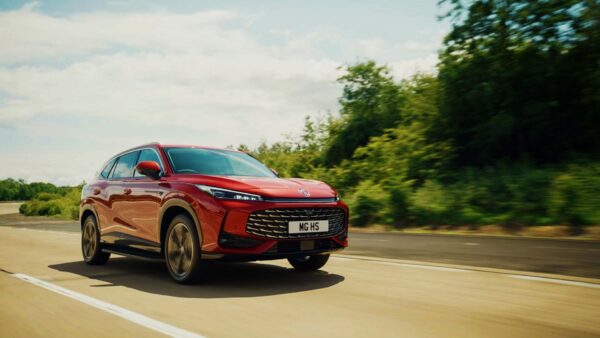
Tested: MG HS Plug-in Hybrid Trophy
Specification
- Max power
- 307PS / 231kW
- Max torque
- 350Nm
- Top speed
- 118mph
- 0–62mph
- 6.8s
- WLTP economy / range
- 565mpg / 75mi EV
- CO₂ emissions
- 12g/km
- BiK
- 5%
- VED
- £110
- OTR price
- £34,995
The first thing I did with the MG HS was plug it into the wall charger. The second thing I did was forget it was even a hybrid.
For most of my week, pottering between villages and doing the long dull loop to the shops and back, it simply ran as an electric car, silent and smooth, the petrol engine sound asleep under the bonnet.
Living with grown children long gone to university, I am precisely the sort of person who no longer needs a family SUV and yet keeps being drawn to how sensible they are. This one – an unglamorous, keenly priced Chinese-built MG – turned out over seven days to be one of the shrewdest company cars I have come across in a good while.
What is it?
The HS is now a genuine big-seller, a mid-size family SUV that has muscled its way into the best-seller lists on a simple promise: a lot of car for not much money.

This latest one rides on a new platform, so it is bigger than before, with proper room for four adults and a boot of 507 litres that, unusually, is exactly the same whether you buy the petrol or the plug-in, because the battery is tucked cleverly out of the way rather than eating into the load bay. There is useful space under the boot floor for the charging cables, too.
It looks smarter than the old one, if still a little generic, and inside you get twin 12.3in screens, wireless charging, satnav and a decent haul of kit as standard, with the Trophy trim adding heated leather, a 360-degree camera and an electric tailgate.
It is well made in a slightly plasticky, built-to-a-price way, and the sophistication, if I am honest, is mostly skin deep. None of that matters much for what this car is for.
The powertrain
This is where the plug-in earns its keep. It pairs a 1.5-litre turbocharged petrol engine with a strong electric motor and a large 24.7kWh battery, for a combined output of around 366bhp and a hefty 419lb ft of torque. That is a genuinely surprising amount of shove for a sensible family SUV, enough to see off 0 to 62mph in about 6.8 seconds, which will catch out anyone who dismisses it on badge alone.
But nobody buys this car to hurry, and the real headline is that 24.7kWh battery, which is bigger than the one in an early electric Nissan Leaf and gives an official electric range of up to 75 miles.
On my week of mixed rural running, I comfortably saw high-60s in electric-only mode, which is genuinely exceptional for a plug-in. For most drivers, most days, the petrol engine simply never wakes up.
Out where I live, with a charger on the barn wall and next to no public rapid chargers for miles, that matters enormously.
Charging is the one place the engineering shows its price. There is a 6.6kW onboard charger, so a full top-up from a 7kW home wallbox takes around three to four hours, which is fine to do overnight while you sleep.
But there is no rapid DC charging at all, so that three to four hours is the quickest you will ever manage. For a home-charging life like mine it is a non-issue. For anyone relying on public charging, it is a real limitation, and worth thinking hard about before you commit.
The drive
To drive, it is comfortable, quiet and completely undemanding, which is exactly what it sets out to be.
The extra weight of the battery has actually done the ride a favour, giving the plug-in a more settled, planted feel than the lighter petrol version, soaking up speed bumps and the ragged edges of country lanes without ever feeling harsh on a motorway. The steering is light and vague and the handling is average at best, so it is no back-road entertainer and never pretends otherwise.
The one genuine irritation – and it is a big one – is the mandatory driver-assistance technology, which bongs, chimes and nags at you constantly until you learn which menus to bury it in.
That aside, as a calm, roomy, easygoing way to cover ground, it does the job with quiet competence.

Brass tax
Now the part that made me sit up, because this is where the HS stops being merely good value and becomes a genuinely canny fleet choice.
Thanks to that huge electric range and CO2 emissions of just 12g/km, the HS plug-in drops into one of the very lowest company car tax bands, around 5%.
On a car with a P11D value of roughly £33,000, that works out at somewhere around £55 a month in Benefit in Kind for a higher-rate taxpayer, and about half that for a basic-rate driver. Let that sink in.
This is a 366bhp, 75-mile-electric, 507-litre family SUV, and it costs a company car driver less per month than many people spend on coffee.
A petrol or diesel equivalent in a high tax band would cost several times as much, and over a typical three-year company car cycle the difference runs comfortably into the thousands. On a salary sacrifice scheme, the numbers become genuinely eye-widening. And because even the top Trophy trim comes in at around £35,000, nothing in the range goes near the £40,000 expensive-car tax threshold, so there is no nasty road-tax supplement lying in wait either.
The rest of the whole-life case is just as tidy. It undercuts the obvious plug-in rivals, the Kia Sportage, the Ford Kuga and others, by something like £5,000 to £8,000, which is a serious gap.
Charged at home, it costs pennies a mile to run, servicing is needed only every 15,000 miles and is cheap when it comes, and MG’s seven-year warranty is transferable, props up residual values and keeps downtime risk low, which is exactly what a fleet manager wants to see. There is even a Vehicle-to-Load function on the plug-in, turning the car into a large mobile power socket for tools or equipment, which is a proper working feature rather than a gimmick. Used values are holding up better than you might expect for the badge, too.
Two things temper the picture, and both are important. The first is the familiar plug-in truth: all of that tax and running-cost magic depends entirely on the car actually being charged.
Leave it on petrol with a flat battery and you are lugging a heavy SUV and a dead 24.7kWh battery around for a thirsty 35 to 40mpg, nowhere near the fantasy economy figures on the brochure. Pair it with a home or depot charger, write a charging expectation into the policy, and the sums are superb. Skip that, and you have bought an expensive way to feel efficient.
The second is timing. Company car tax rates on plug-in hybrids are set to rise over the coming years, with a notably steep jump expected in the 2028/29 tax year, so the sweet spot you sign up for today will narrow before a typical fleet cycle is out. Build that into your whole-life sums rather than assuming today’s tiny percentage lasts forever, and confirm the live band at the point of order.
The verdict
After a week, I came away with a clear view: the MG HS plug-in will not thrill you, and it does not try to.
What it will do is carry your family in space and comfort, run silently on electricity for the vast majority of your driving, and, if you run it as a company car, hand you a tax bill so small it feels like a mistake. It is not the most polished thing in its class, and the technology can drive you to distraction, but as a piece of cold fleet arithmetic, very little on sale right now comes close.
Charge it religiously, spec it sensibly, and it is one of the smartest company car decisions you can make today.

Fleet Focus
1. TCO – Total Cost of Ownership
- Capital Cost Structure: Entry-level On-The-Road (OTR) pricing starts at £26,495 for the petrol SE Manual, rising to £32,495 for the SE Plug-in Hybrid and £34,995 for the range-topping Trophy Plug-in Hybrid.
- Taxation & BIK Liability:
- Plug-in Hybrid (PHEV): Thanks to a large 24.7 kWh battery delivering an official WLTP combined electric range of 75 miles and emissions of just 12 g/km, the MG HS PHEV qualifies for an exceptionally low 5% Benefit-in-Kind (BIK) rate (for the 2025/26 and 2026/27 tax years).
- 1.5T Petrol (ICE): Outputs 168–173 g/km, attracting a 37% BIK tax rate.
- Asset & Residual Warranty: Standard factory protection includes a transferable 7-year / 80,000-mile vehicle warranty and an 8-year high-voltage battery warranty on hybrid models.
2. Fuel Efficiency
- PHEV Range & Efficiency: The Plug-in Hybrid pairs a 1.5-litre turbocharged petrol engine (142 PS) with a 209 PS electric motor to generate a combined 371 PS and 419 lb-ft (569 Nm) of torque. It delivers up to 75 miles of EV-only range (84 miles city cycle) and a weighted combined fuel economy of 672.6 mpg (0.42 L/100km).
- ICE Petrol Efficiency: The standard 1.5T 4-cylinder petrol engine (169 PS / 202 lb-ft) returns a combined 37.2–38.2 mpg.
- Long-Distance Capacity: All model variants feature a 55-litre fuel tank, guaranteeing long-distance range stability.
3. Maintenance Cost
- Service Intervals: Servicing is required every one year or 15,000 miles, providing higher annual mileage thresholds before requiring workshop maintenance compared to standard 10,000-mile caps.
- Component Load Reduction: Plug-in Hybrid models utilise cooperative regenerative braking to recharge the battery, significantly reducing physical brake disc and pad wear during urban stop-start driving.
4. Downtime
- AC Rapid Charging Uptime: The PHEV’s 24.7 kWh battery charges from 0–100% in 4 hours via a standard 7kW wallbox (or 7.5 hours via a 2.2kW 3-pin domestic outlet).
- MG Pilot Custom Function: Reduces driver setup time at start-up. Safety regulations reset ADAS features every time the ignition is toggled; MG’s custom system allows drivers to save their preferred ADAS settings and re-apply them in 2 touches via a swipe-down touchscreen shortcut.
- Remote Management: The iSMART smartphone app provides remote cabin pre-heating/cooling, door locking/unlocking, battery/fuel level monitoring, and charging schedule control. PHEV variants also include standard Vehicle-to-Load (V2L) capability to run external equipment.
5. Safety
- Comprehensive ADAS Shield: Fitted as standard with the MG Pilot suite, including Active Emergency Braking (with Pedestrian and Bicycle Detection), Adaptive Cruise Control, Lane Keep Assist, Blind Spot Detection, Door Open Warning, and Active Rear Cross Traffic Alert.
- Passive Crash Shield: Built with a front centre interaction airbag (preventing head-to-head front passenger impacts), side curtain airbags, and standard ISOFIX child seat anchor points.
- Maneuvering Protection: Trophy trims upgrade the rear parking sensors to a 360° HD Surround View Camera (including under-chassis view) to mitigate low-speed scraping damage.
Key rivals
- Kia Sportage PHEV
- Hyundai Tucson PHEV
- Ford Kuga PHEV
- VW Tiguan eHybrid
- BYD Seal U DM-i
- Jaecoo 7