
Shell unveils Triple 10 Challenge Concept Car
This EV is designed to demonstrate electric vehicle capability and aims to offer the industry an alternative to the current reliance on ever-larger batteries.

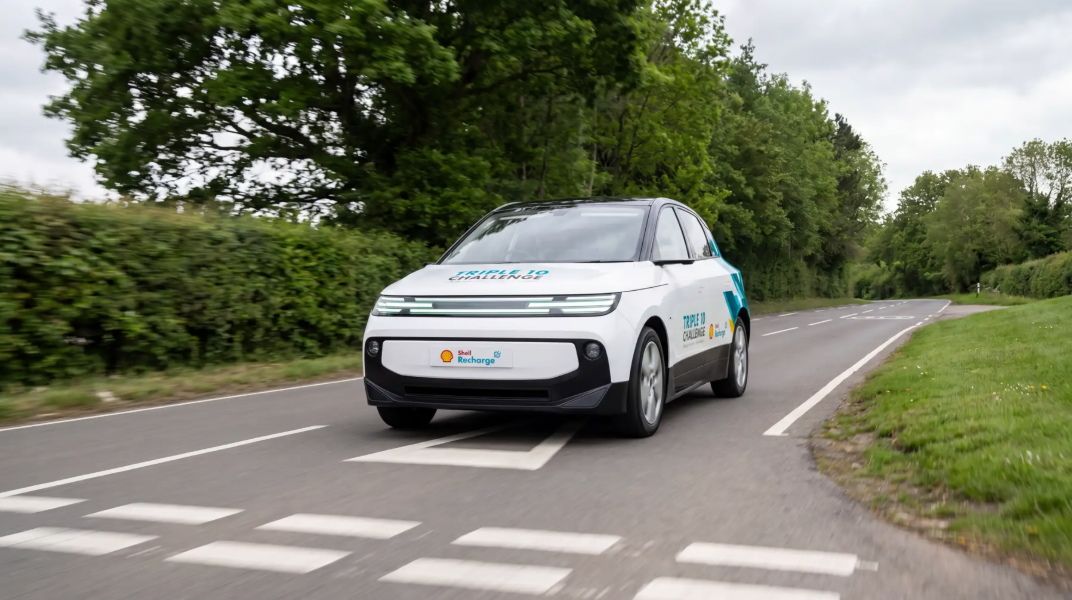
Shell has unveiled its Triple 10 Challenge concept car, a proof-of-concept vehicle designed to inspire a new design philosophy for the next generation of battery electric vehicles (EVs).
The compact EV was designed to demonstrate electric vehicle capability, and to offer the industry an alternative to the current reliance on ever-larger batteries by re-imagining the fundamentals of thermal management.
The vehicle is designed to ‘Charge Faster’ in under 10 minutes, ‘Go Further’ with 10-km/kWh economy, and ‘Drive Cleaner’ with a life cycle 10-tonne CO2e footprint.
The Triple 10 Challenge was built to demonstrate the potential of a simplified, single-circuit cooling architecture to efficiently manage the thermal load of the car’s entire powertrain, even under the most extreme fast-charging scenario in real-world conditions.
Cara Tredget, VP of mobility and lubricants technology for Shell, said: “With the Triple 10 Challenge concept car, we have unlocked the potential for faster charging, lighter systems and improved lifecycle efficiency by using our advanced thermal fluids.
“Together with our co-engineering partners, we are proud to develop alternative options for sustainable EV development leveraging technologies that are available today and are scalable to support customers into the future.”
The Shell Triple 10 Challenge Concept car was designed to achieve 10 km/kWh in driving economy with a smaller, more efficient battery system, to add over 30% improvement in overall energy efficiency compared to many current-generation EVs, enabled by Shell’s advanced thermal fluids.
The Triple 10 Challenge vehicle is able to charge the battery from 10% to 80% charge in nine minutes 54 seconds, without compromise to thermal stability or lifespan, according to Shell.
Related
Arnold Clark Charge adds six ultra-rapid EV chargers in Huddersfield
Ayvens and Fellten to offer UK fleets charging flexibility

Autumn Budget 2026: Industry calls for EV support through VAT cuts and grid reform
BMW UK launches tailored Chauffeur Programme service package

VWFS and Jumptech partner to enable home charging for employees
BYD launches ATTO 8 at Paris Motor Show
Zapgo opens charging site at Cartmel Racecourse
Source UK EV chargers added to Shell Card network
Government considers tariffs on Chinese EVs

Tesla Superchargers available through bp roaming network

Fastned calls on Govt to level VAT playing field as public charging found to cost £270 more per year