



DOUBLE cab pick ups have come a long way from just being the farmer’s friend or a utilitarian vehicle supporting builders. They are now built to suit all purposes – from the original tough working tool to the luxurious high spec variant. No wonder they have become the favourites of property developers with their rugged looks but well-specified interiors.
But many company car drivers choose them as company cars – because they like the looks, the functionality of them and so on.
But choosing a double cab as your company vehicles also means that company car tax benefit in kind is payable.
However, that hasn’t been all bad news. The benefit in kind tax you pay on a double cab pick up is currently a lot less than if you drove a company car.
But all that could change with an August 2017 court ruling in favour of HMRC that a VW Transporter T5 Kombi with second row of seats was in fact a car. See our report here.
Currently, HM Revenue & Customs classifies these pick ups as vans – as long as they have a payload of 1 tonne (1000kg) or more. A payload means the vehicle’s gross vehicle weight less its unoccupied kerb weight.
Where a pick up has a hard top, this is given a generic weight of 45kg. So a pick up that has a payload of 1010kg will convert to a car under these definitions. So it’s important to ensure your pick up qualifies for company double cab tax if you want to choose one as your company car.
However, if you are a company car driver, there are plenty of choices out there – and the ride comfort of these machines has improved immeasurably. Here are some of our favourites (which includes the Fiat Fullback picture above):
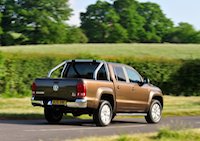
Volkswagen Amarok – Double cab pick-up combines car-like comfort with full off-road capability
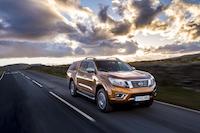
Nissan Navara – Efficient engines, superior comfort, and great towing ability
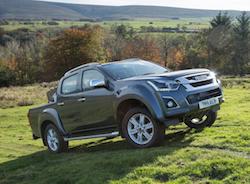
Isuzu D-MAX – New 2017 with new engine, 360Nm torque for 3.5 tonne towing ability

Ford Ranger – Hugely popular, does the muddy stuff and the on-road bits equally well
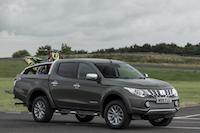
Mitsubishi L200 – Series 5 model launched 2015, but still desirable
What are the company double cab tax rates?
For the tax year 2017-18 the benefit in kind on a double cab pick up is rated at £3230. So if you pay income tax at 20% that’s just £646 a year; or £1292 if you are a higher rate 40% tax payer.
That’s really not a bad option compared to what you might be paying on a company car – a Ford Focus diesel Titanium X, for example, would cost you £1010 (20%) or £2019 (40%).
What about ‘free fuel’ for your double cab?
If your company also pays for private mileage fuel in your double cab pick up, you as the driver is taxed on this, too. The annual company double cab tax liability for free fuel is £610 – the same as the van fuel benefit.
- So a 40% income tax payer will be charged 40% of £610 for free fuel: £244 per year. That’s in addition to the £1292 company double cab tax.
- For a 20% taxpayer it’s £122 on top of the £646 double cab tax.
- Whichever way you look at it, that’s a useful way to lower your benefit in kind car tax exposure for driving a company provided vehicle.
However, if you cover no private mileage, there is no tax to pay. The taxman does not count driving the pick up between home and work as private mileage. So if you take the pick-up home at night and do no other mileage, you do not have to pay company double cab tax.
Use our company car tax calculator
- Work out what you’ll pay in tax – click here for our company car tax calculator
- Includes double cabs!
The taxman allows some ‘insignificant’ private use: such as dropping a child off at school on the way to work. But if the double cab pick up is regularly used to do the supermarket run, or for family weekends away, that is counted as private mileage. In reality, most double cabs are used for private as well as business use.
An employer pays Class 1a National Insurance on taxable benefits – this includes company double cab tax.
Keep a mileage record
HM Revenue & Customs suggests that to avoid possible confusion, and tax liability, a mileage record is kept; an agreement is signed about vehicle use; use of the vehicle is put into a contract of employment.
In reality, most luxuriously equipped double cab pick ups, are likely to be used for private mileage.
Company double cab tax is not applicable if the owner is a sole trader or partner.
- It is worth talking to a tax planner, such as an accountant, if you want to understand the full tax implications of running a double cab pick up.
How can you reduce your tax exposure?
- Find out more by going to our company car tax section.
Related
Autumn Budget 2026: No eVED reform despite industry outcry

Autumn Budget 2026: Healey plans to freeze fuel duty

Autumn Budget 2026: Industry calls for EV support through VAT cuts and grid reform
Diesel-related incidents up 21% from March to October 2026

Just two in five fleets have payment management “under control” – Cubic³

Private chargers are lacking maintenance – Safer Charging

Citroën expands C5 Aircross lineup with ‘Emerald’ trim

Vertellus launches free EV transition toolkit for fleet operators
In-car technology and driver distraction cause one in three crashes – Allianz

EA-RS Group appoints Ogilvie Fleet to support vehicle operations

Toyota, Waymo start autonomous vehicle testing in Japan, UK deployment planned