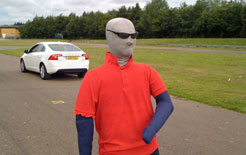
 MEET Bob the dummy, left.
Bob is the poor sap who gets driven at by journos in Volvo’s new S60 when it’s equipped with the new Driver Support Pack (cost £1250 on SE and above) to demonstrate the system’s capabilities.
The Driver Support Pack includes a stackful of additional Volvo safety kit, but includes the debut of Volvo’s potentially life-saving system for pedestrians, called Pedestrian Detection with ACC (Adaptive Cruise Control). It works through a radar mounted on the front of the grille and a camera that sits on the front windscreen behind which is mounted the rear view mirror.
Essentially the radar measures speed and objects; the camera works out if they are pedestrians.
At speeds below 22mph the car will brake automatically if it detects that the driver is taking no preventative action. To prove the system works, we drove towards Bob at 20mph. To say this is one of the most unnerving experiences I’ve ever done is an understatement. Every muscle, sinew, nerve and brain pulse in your body tells you to stamp on the brake, and swerve to avoid Bob.
But in the interests of finding out if Pedestrian Protection works, you keep your foot on the throttle and keep going towards the unflinching Bob. With a flash of red, warning lights ping on from the dash, and then the brakes go on and…inches from Bob, the Volvo stops. Hooray! It works, and Bob lives to fight another day. Phew!
The potential to save injury to pedestrians is immense. Just a second’s inattention and you could be running a real person down. But not with Volvo’s Pedestrian Detection.
But that’s all very well for speeds of 20mph or so. What about 30mph, a more typical urban speed? As Chris Wailes – Volvo’s European product & pricing manager – explained to me, the law of physics takes over. So while the Volvo can’t stop in time the system will, nevertheless, mitigate the potential for fatal injury by reducing the impact speed to 11mph (click on the second picture left). It would leave Bob probably with a broken leg, but has significantly reduced the potential for something more life-threatening.
To say that running into Bob was gruesome was an understatement. Horrible just doesn’t come into it. “During testing we had to drive towards many young Bobs, too,” explained Chris. “They were dressed in jeans and t-shirts and looked so life-like it was very difficult to do, because it’s so counter-intuitive. But we had to test the system to make sure that it worked in every situation from a youngster measuring 80cm to a full-grown adult.”
Perhaps more rewarding for Chris was fine-tuning the Volvo S60’s chassis in association with former touring car champ John Cleland (a long-time Volvo dealer incidentally) so the car was suitable for UK roads. These suspension settings will be used throughout Europe.
Driving the S60 quickly down challenging A-roads and you can sense the presence of Cleland. The car is precise, taut and controlled. Quite unlike any Volvo I have ever driven before. However, the team should, perhaps, have paid a bit more attention to the low-speed ride. While the car flattens out nicely at speed, at lower speeds it becomes choppy and agitated.
One final observation, should you be inclined to order a Volvo S60, then go for the three-spoke dual colour sports steering wheel. It only costs £100 extra – but the looks and feel really make it worthwhile (click on the third picture left). It will enhance your period of ownership for a very small outlay. For a slightly larger outlay, of course, you could possibly avoid unintentionally running over a pedestrian, too.
And all thanks to Bob.
Business Car Manager: Editor’s Blog