VEHICLE workshops throughout the UK face a problem. The issue is one of space.
Having a busy workshop to repair vehicles damaged and sent in for repair presents unique challenges around having enough drive bays to place each vehicle ready for repair. A flexible solution is needed for different workshops, each with their own concerns about housing mechanics and equipment while not being too cramped to complete repair or servicing tasks.
What’s needed is a flexible approach to building structures. It is not something that’s previously been hugely popular. Fixed building structures the norm, yet they’re not always ideal. Putting up a second building next to the first one requires difficult to obtain planning permission, enough space to do so, a long timeline to design and build it, and what will the workshop do in the meantime?
Too little space, too many workers
While the tyre replacement, repair workshop, or servicing and testing centre may require more bays to place vehicles and have employees work on them, soon enough the business runs out of bays. They can employ more mechanics and they have enough customers with vehicles waiting, but they cannot get them in and out of the workshop fast enough. There’s simply not enough space for each vehicle and the machinery to work on it.
Real cost of relocating a business to a new premises
The usual solution is to look for a different location to relocate the entire workshop. For one that’s located in an easy to reach location, finding another place that is simple for UK customers to drive to isn’t so easy. The risk is, the greater distance away it’ll be necessary to relocate the business, the more customers the local business risks losing in favour of other businesses that are closer to them. There’s also the issue of the employees, some of whom won’t be delighted to discover their commuting time just doubled.
For a workshop that needs to relocate, even if it can find another suitable place, they’ll be the increased costs for the bigger parking space in the front, the reception area, and the enlarged covered workshop area. Add to that the lost customers’ sales, the uplift in marketing spend to find new customers, the cost of layoffs and to recruit of new employees, and it begins to look uncomfortably high for small workshops needing to expand.
What solutions are available?
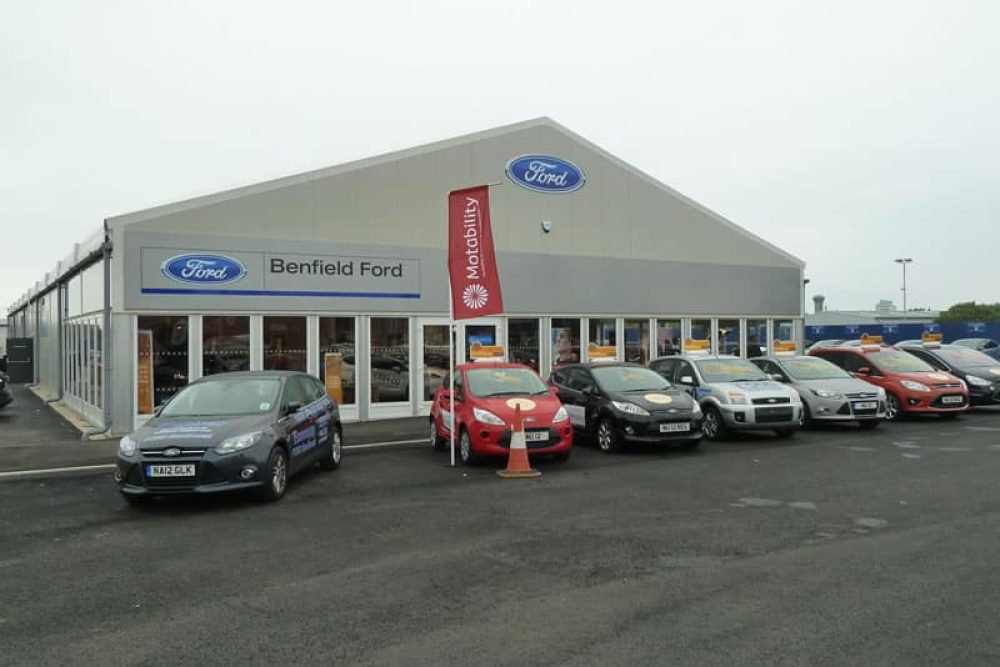
One idea is to use existing land currently designated for parking. Using temporary buildings, it’s possible to add one or more new structures to reduce the emphasis on a single workshop location. These temporary structures make the best use of existing space under the company’s control and require fewer building permissions from the local council before building the structure.
The Smart Space workshops are configured for motor workshops that need a secondary structure. With previous experience of creating different short-term buildings for the automotive industry, Smart Space make an ideal partner to plan and build out a new structure to expand the business’ capabilities.
Smart space workshops
There are different options available with Smart Space workshops, depending on what the business needs. The walls, for instance, can be provided without insulation or with cladding to make the interior of the structure warmer. When condensation is a concern, roof covers can have anti-condensation features with improved insulation from the outside environment to keep moisture out.
While new structures can be created, it’s also possible to erect a temporary building that augments one that already exists. The building can be appended to the existing workshop to add space for several more drive bays to work on more vehicles at the same time. Doing so is much cheaper and faster than having to develop an extension or a whole new brick building.
Given their previous experience in the field, the company can provide full documentation for an existing workshop design for use in a local council building application. Having this available does save time. The fact that the company has produced many of these similar workshops before is likely to be considered by the council too. However, typically, temporary structures received faster approval anyway.
Custom or special use buildings
Another way to go is to consider a custom or special use building. This can either be one that is designed for a specific client or with one or two planned uses in mind. One approach to take is to think about what activities can be moved from the main workshop to a temporary building elsewhere? This could be the wheel tracking equipment, MOT testing area, the servicing area, or even a tyre bay where customers drive in to get their tyres inspected and possibly replaced.
One case in point is P.J. Lintern, which had a special tyre bay building created. It freed up space in the workshop to install another vehicle ramp which enabled detailed vehicle repairs to be completed sooner and not have to wait for more limited access to the existing ramps.
Another example is the Hughes Mercedes Smart Repair. For Mercedes owners, the dealer needed a bay where vehicles could be valeted for the owner. The roof had fitted skylights to let in more natural light and came complete with anti-condensation features to prevent added moisture when cleaning the interior of the vehicle.
Interim workshop buildings
While there are temporary buildings that usually are only needed for a few months up to three years in total, there are also other options for faster build premises. One step up is the interim building.
The interim building is one that straddles between short-term and long-term use with an expected useful life of seven years and an expected minimum use of three years. Modular design is expected to make fabrication and building quicker with swifter approval by local authorities too. Interim buildings for a workshop usually sport a steel roof with insulating cladding to provide some energy-efficient management inside and qualify for new energy efficient regulations too. These types of buildings do not require a foundation or footing in place first, which speeds the whole process up.
For companies without a long-term lease beyond 5-10 years on the property, an interim workshop building is a reasonable option. It delivers greater security for heavy-duty equipment installed on the premises and better protects any vehicles held inside the workshop overnight or over the weekend. With freak storms becoming more commonplace in recent years, having the security of a steel roof is something some workshop owners might find preferable.
Steel workshop buildings
Another way to go is a full steel workshop structure. These must meet the recent Building Regulations L2A to qualify as an appropriate structure. The focus here is on energy efficiency, which is where the different cladding insulation options in both the roof and walls come into play. Customers can choose the amount of cladding they wish to have installed, up to a set maximum. Extra cladding costs a bit more but reduces the energy bill, so it pays for itself over time.
The advantage of a steel workshop is that it’s likely to last at least 30 years and possibly up to 35 years. The cost to put up the building is far lower than paying for an architect to design a brick and mortar building and then having it built. Due to the modular design principles employed, steel buildings are easier to get approved too. Getting a steel building erected is much quicker than a brick and mortar one too because the pieces essentially slot together.
Repairing or modifying a steel workshop building
A steel workshop can be modified to extend it a greater distance with the right planning permissions and space to do so. Adding a brick and mortar extension to a regular building is far more difficult to get approved and completed. And should a customer or member of staff lose control of a vehicle and hit the side of a steel wall? The good news is that the wall panels are eminently replaceable.
Workshop owners have more choices
While UK business owners in the automotive industry used to work with a restrictive list of options for buildings, thankfully that’s all changed. Newer legislation has made environmental concerns, including the appropriateness of a building placement, a priority, and energy efficiency is also something that’s a high priority too.
Temporary buildings, along with interim and steel buildings, are good options to expand work premises without needing to relocate the whole business. They offer less environmental impact and greater energy efficiency in many cases while allowing companies to expand their facilities so their business doesn’t miss a step. The cost savings would be great, but the reduced disruption of not having to relocate an entire operation by using a temporary or interim building is reason enough to get on-board.
For motor workshop owners and main dealers that have a workshop adjacent to their vehicle showroom, being able to expand at a lower cost while staying in the local community is an ideal solution when requiring more workshop space. The cost benefits are just a bonus.