BRITAIN’S ability to compete as an electric vehicle production leader is at risk unless government responds urgently to increasingly fierce international competition, the Society of Motor Manufacturers and Traders (SMMT) warns in a new blueprint.
The call comes as other countries significantly power up political and economic backing for their own automotive sectors, positioning themselves at the front of the queue for investment.
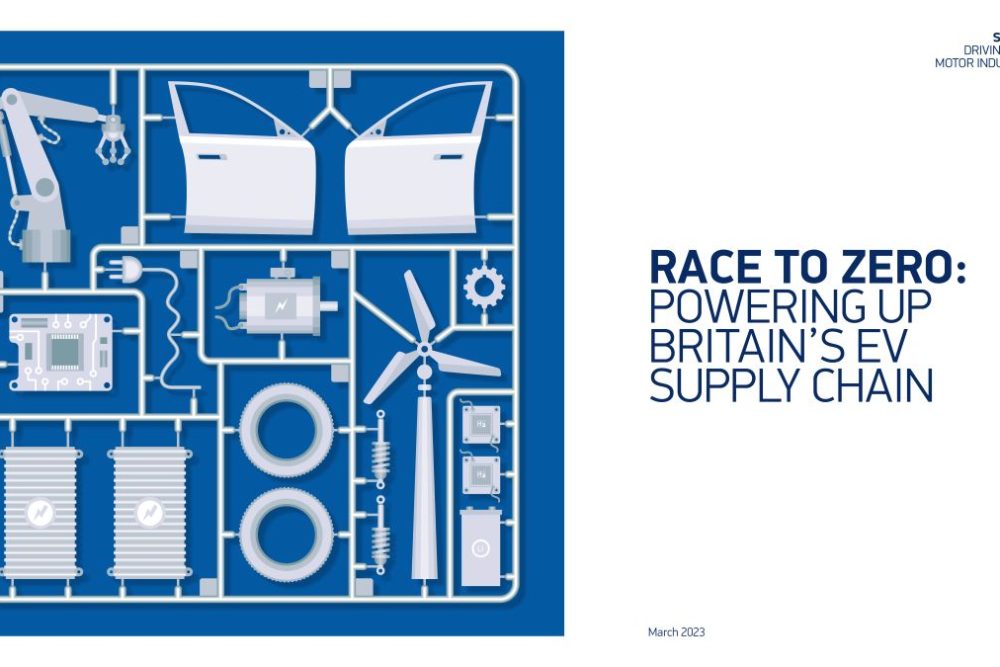
Race to Zero: Powering Up Britain’s EV Supply Chain sets out the UK’s intrinsic strengths in advanced automotive manufacturing, low carbon energy and R&D, but stresses the need for an urgent response to initiatives such as the US $370 billion Inflation Reduction Act and EU Green Deal Industrial Plan.
The blueprint sets out a Green Automotive Transformation strategy that would position Britain as one of the world’s most competitive locations for advanced automotive manufacturing, matching its world-leading market ambition to end the sale of non-zero emission cars and vans in 2035.
The strategy identifies investment, regulation and trade as the key pillars to anchor future vehicle production in Britain. De-risking private capital with more competitive incentives and action on energy costs, with support for the next British ‘unicorns’ in batteries and renewables, will stimulate greater investment in EV enterprises.
Reform of regulation will accelerate delivery of new production facilities and renewable energy generation. Maximising trade opportunities, meanwhile, would help secure access to essential raw materials. Such moves will secure the essential gigafactories which can underpin EV production.
The UK must act on the significant progress made by the domestic automotive sector and supply chain – and its inherent advantages. To date, more than £11 billion has been invested by manufacturers in EV production locally, leading to fully electric or hybrid vehicles comprising almost a third of all UK-built cars last year, with an export value of £10 billion.1 By 2025, the sector is anticipated to produce more than 20 models of electric cars, vans, buses and trucks, contributing to the economy and jobs in all regions of the country.
Meanwhile, every part of the UK contributes to the EV supply chain, with a 25% increase in the number of these businesses in the last five years.2 Seventeen of the world’s biggest automotive suppliers have a UK base,3 and a new SMMT EV Supply Chain Directory reveals that Britain produces almost every component required to manufacture tomorrow’s zero emission vehicles in some capacity. From batteries, powertrains, fuel cells and power electronics to anodes, rare earth magnets, graphene and silicon carbide wafers, the UK’s capability can and must be scaled up quickly.
British-built EVs and their components also benefit from greener production, with the UK ranking seventh best in the world’s top 20 automotive manufacturing nations for low carbon energy. Indeed, British energy generation emissions are some 17% lower than the EU average, and lower than those in Germany, the US, Japan and China.4
Britain also ranks highly for university-industry R&D collaboration, a vital relationship in the development of new technology for zero emission vehicles. Add in our highly skilled and flexible workforce, undoubted engineering excellence, and a market and consumer that embrace new technologies, and the UK has much to offer. Both industry and government must build on those foundations, bolstering Britain’s attractiveness as an investment destination for electric vehicle and component production.
Mike Hawes, SMMT Chief Executive, said, “Britain boasts a firm foundation of EV production, backed by low carbon energy, outstanding R&D and a highly skilled and productive workforce. We must not squander these advantages. With other parts of the world turbocharging their support for the zero emission vehicle transition, we need to step up to compete in this global race. Every part of the country has a stake in the switch and with fast, decisive action we can deliver for Britain the growth, jobs and green prosperity this country deserves.”