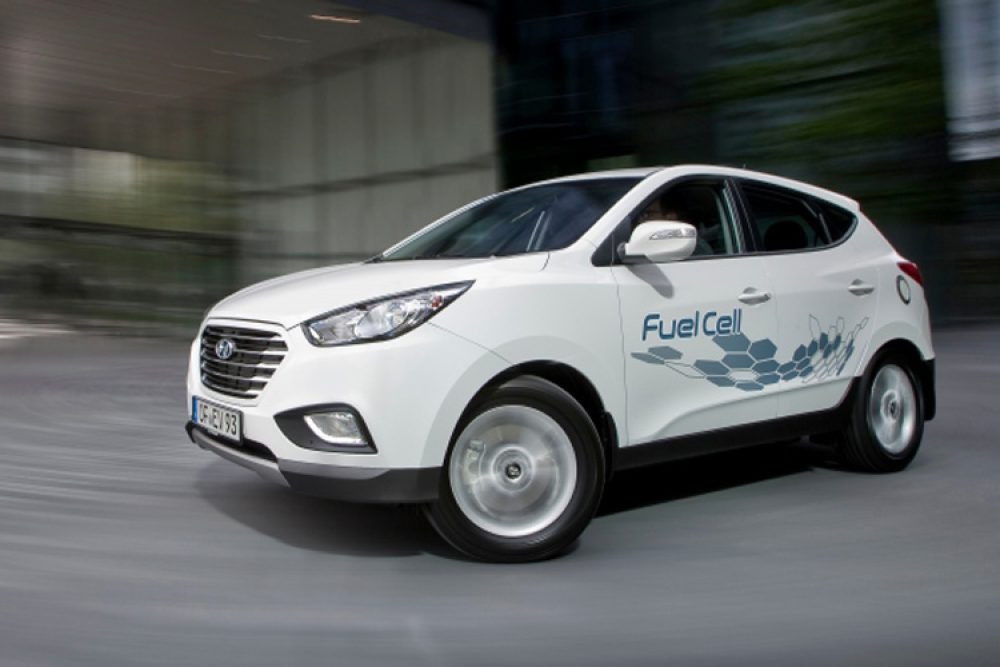
HYUNDAI will launch the Hyundai ix35 Fuel Cell in 2015.
It will be the first series production hydrogen fuel cell car in the UK.
Unlike standard electric cars (EVs), a fuel cell car produces its own power on the move thanks to a chemical reaction between hydrogen and oxygen (see below).
What is a fuel cell vehicle?
- A fuel cell electric vehicle (FCEV) is an all-electric car, van or bus. It doesn’t rely on a battery holding its charge between top ups at the mains. Instead it produces its own electricity on the move through a chemical reaction between hydrogen and oxygen in a metal box known as a fuel cell stack.
- An FCEV has a range on a tank of hydrogen that’s roughly the same as a vehicle with a petrol or diesel engine. However, the only waste product is water vapour.
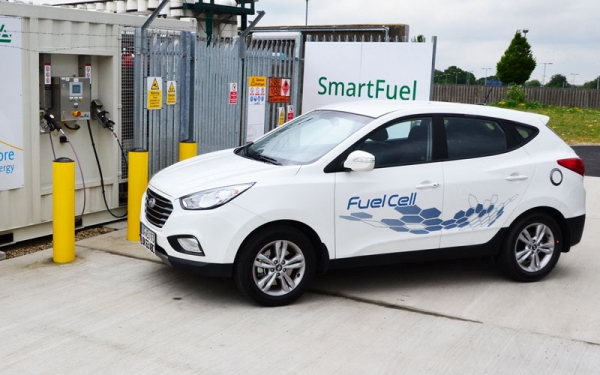
- An FCEV is refuelled in the same manner as a normal petrol or diesel car or van.
- Click here to read our first drive of the ix35.
The cars are silent in operation and have zero emissions.
Hyundai has already started production of the car and plans 1000 vehicles from now until 2015 and 10,000 vehicles from 2015 onwards.
“Everyone has been talking about the fuel cell being the answer for ever,” said Tony Whitehorn, chief executive of Hyundai UK, at the car’s presentation in London. “Now it is within reach.”
The 2015 launch of the Hyundai ix35 Fuel Cell will be supported by a network of 65 hydrogen fuel filling stations sited in main conurbations and on key motorway routes. By 2025 this network will expand to 300 with plans for 1150 by 2030.
It also has political support from the Mayor of London’s office, with a commitment to introducing a minimum of six filling stations to the capital by 2015. Kit Malthouse, deputy mayor, said:
“We believe fuel cells are the vehicles of the future. Not just because they are green and because we have emissions problems in the city, but because they are better. Electro-chemistry is much better than burning oil.”
A price for the Hyundai ix35 Fuel Cell, which will be two-wheel drive only, has yet to be announced. Whitehorn said he was in discussion with government about grants to help lower the price.
At present there are no indications as to what that will be, but expect a substantial premium over the standard ix35.
However, fuel cell prices are expected to lower to a small premium by 2020 and reach diesel vehicle parity by 2030, according to analyst Alex Stewart.
Stewart said that research suggested early adopters would be SMEs wanting a technologically green car statement, public sector and larger company car fleets.
The Hyundai ix35 Fuel Cell will fall into the new 5% company car tax band for vehicles emitting 0-50g/km CO2 in 2015.
“The government wants to leverage tax pressure on company cars and I can foresee this getting heavier on high carbon emitting vehicles,” noted Whitehorn. “The new Hyundai ix35 Fuel Cell falls into the lowest company car tax band with its zero emissions.”
Not only will the Hyundai ix35 Fuel Cell fall in to the lowest company car tax band, running costs look to be minimal too.
The cost of hydrogen is slightly cheaper than diesel but the real savings are on running costs. A service is required every six months or 6000 miles just to replace two filters but otherwise the fuel cell stack is a sealed unit, and expected to last 100,000 miles before and significant refettling.
Regenerative braking will also help preserve the life of the brakes and tyres.
Fuel cell vehicles are well suited to SUVs such as the Hyundai ix35 and larger cars due to the size of the fuel stack. Fuel cells are less suited to small cars which are better suited to fully electric propulsion for zero emissions.
Whitehorn, bullish about the prospects for the Hyundai ix35 Fuel Cell, concluded: “In the same way that the jet engine revolutionised air travel, the fuel cell will revolutionise car travel.”
The Hyundai ix35 Fuel Cell is the third generation of Hyundai fuel cell development spanning 15 years.